
Rockville Previous Residents by Era
Finding past residents of Rockville means pairing records that answer different questions. Work backward from the present parcel through recorded deeds. Then layer in sources showing occupants, construction, or an address that no longer exists. Online coverage has limits. A printed directory lists a household but proves nothing about ownership. Each era carries its own access route. Free public indexes, appointments, counters, and microfilm readers all play a part.
| Source | Years It Covers | Where Held | What It Shows |
|---|---|---|---|
| MDLandRec modern index | Guide showed Jan. 1, 1977 to Nov. 7, 2025 | Maryland Land Records and Circuit Court public room | Recorded parties, deeds, liber/folio, images, and prior references |
| Land books and equity indexes | Back to July 1777; equity books 1777-1981 | Maryland State Archives and court records | Earlier title and equity trail |
| Rockville directories and telephone pages | Scattered confirmed editions and cataloged periods | Peerless, Archives, Library of Congress, Sween | Listed residents, addresses, business and phone clues |
| Federal census | 1790-1950 open schedules | National Archives access and library databases | Household-level evidence by enumeration area |
| Permits, maps, and Lusks materials | Period depends on record set; Lusks 1951-1993 | Rockville systems, Library of Congress, Montgomery History | Alterations, building form, property sale and address context |
Older eras need more than the online deed index. Its stated range is not a wall. The Maryland State Archives holds historical land and equity material, and local researchers can turn to the Circuit Court public room, Sween appointments, Peerless requests, or Rockville Memorial Library microfilm when an online result is missing.
Rockville Previous Residents Begin at SDAT
Every search begins at the Maryland SDAT Real Property Data Search. Select Montgomery County. You can search by street address, street name, account identifier, or map reference. Owner name is not accepted there. Neither are town, neighborhood, subdivision, or ZIP. When an address resolves, write down the owner shown, mailing and premises addresses, legal description, tax account, liber/folio, transfer date, seller, and sale price when present.
The premises address is the physical location. The mailing address is where assessment and tax mail goes. The two often differ. A legal description, such as a lot, section, subdivision, unit, or metes-and-bounds text, usually outlives a familiar street name. Liber and folio form the book-and-page reference tying the parcel card to the land-record image. That reference serves a historic trail far better than an address alone.
For city-limit and neighborhood checks, use Rockville's maps and open-data resources or the county property viewer. A Rockville postal label does not place the parcel inside the city. Record the municipal status along with street, ZIP, and source date.
Rockville Previous Residents and the Deed Chain
The MDLandRec index is the core tool for tracing title. It carries a present parcel into the past. Searching works by party or name, tax account, liber/folio, and cross-reference. Montgomery is the one Maryland county with a shortcut. It allows the SDAT Tax Account Identifier directly in the land-record search. Deeds are indexed under grantors and grantees rather than street addresses. Run the SDAT conversion step first.
- Search the current address in SDAT and save the legal description, tax account, owner, and liber/folio.
- Open the corresponding MDLandRec document and note deed date, recording date, grantor, grantee, consideration, document type, and prior reference.
- Search the current grantee as a grantee to locate that person’s purchase deed.
- Take the seller or grantor from that acquisition deed and search the seller as an earlier grantee.
- Repeat the loop, following lot, block, plat, condominium, or parent-account references when an address changes.
- Grantor
- The party giving or conveying an interest in a recorded instrument, usually the seller in a deed.
- Grantee
- The party receiving the conveyed interest, usually the buyer in a deed.
- Chain of title
- The ordered set of recorded transfers used to trace a parcel’s ownership history backward.
- Liber/folio
- The book and page reference used to locate a Maryland land record.
- Legal description
- The formal parcel description, often stronger than a street address when roads are renamed or property is subdivided.
Rockville Previous Residents After 1977
The MDLandRec user guide lists a modern online index for Montgomery running from January 1, 1977 through November 7, 2025. Maryland moved to an updated Land Records website in November 2025. Confirm the live cutoff and search behavior before relying on the guide's date. The account is free after a first-use application with a valid email. The Circuit Court public room also has computers for Montgomery and other Maryland counties.
The Montgomery County Circuit Court Land Records Department sits at 50 Maryland Avenue, North Tower, second floor, Room 2120. Its public-information room is open Monday through Friday, 8:30 a.m. to 4:30 p.m. Recording closes at 4 p.m. Ask the public room about the index and image process. Call the duplication staff when the form of a copy matters.
The county page prices certified copies at $5 for certification plus $.50 per page. Check regular image or print costs with duplication staff. An index entry is a finding aid, not a certified deed.
Rockville Previous Residents Before Online Records
Montgomery land records date to July 1777. The online guide's modern range does not mark the start of the record trail. Historic land books and the county's equity indexes reach farther back. Montgomery equity index books covering 1777 through 1981 are held at the Maryland State Archives. Equity material matters when a property story involves court-supervised transactions, estates, or other nonroutine transfers.
When a liber/folio trail stops online, carry the legal description, party names, document dates, and every prior-reference citation to the Maryland State Archives guide and to Circuit Court staff. Staff can help locate a book or decode a reference. An old index hit still demands inspection of the document itself and its party roles. A lien, judgment, mortgage, or plat can place a name near a parcel. That alone does not prove ownership.
Note: Follow the instrument type as well as the name. Only a deed ordinarily carries the title-transfer step.
Rockville Previous Residents on Changed Streets
An old address is not a person trail. Rockville renamed and renumbered its streets over time. Build the address bridge before the name chase. The best documented case sits at 801 N. Washington Street in the 1968 city directory. A city historic survey tied that entry to today's 801 Hungerford by comparing street intersections and address sequence. The 1975 roadway widening reshaped the corridor, and Metrorail arrived in 1984.
One example does not prove citywide renumbering. Treat each address on its own evidence. Set the old directory's neighboring intersections beside the deed legal description, subdivision plat, historic map, and current GIS. Save every address version in the trail. Keep both "Washington Street" and "Hungerford" where the evidence supports the connection, so a missing address can be retested under the earlier road name rather than mistaken for a missing resident.
Rockville Previous Residents in Directories and Census
A deed records one thing: a transfer of ownership. Previous residents of Rockville may have been renters, relatives, or other occupants who never enter that chain, so the residents directory and census carry the fuller household story. Start with the Rockville directory collections for surname and address evidence. Match each directory period to an open census year. The open federal schedules run through 1950. Shifting city boundaries and Montgomery enumeration districts can file the same household under a rural or postal label.
- Start with a dated directory entry and transcribe the exact surname, initials, spouse or widow notation, address, and occupation.
- Check the nearest available directory and its street or address section for the same place.
- Compare with the nearest 1900, 1910, 1920, 1930, 1940, or 1950 census schedule.
- Use Sentinel notices, obituary clippings, probate files, or estate records to explain a move or disappearance.
- Keep household presence separate from recorded title in the final notes.
The Sentinel offers a long newspaper trail. Issues from 1855 through 1963 are digitized. The 1964 through 1969 years are searchable on Sween reading-room computers, and 1970 through 2020 sits on Rockville Memorial Library microfilm. Before assigning a clipping to the parcel, weigh its address and date, since these sources document deaths and family relationships well.
Rockville Previous Residents in Maps and Permits
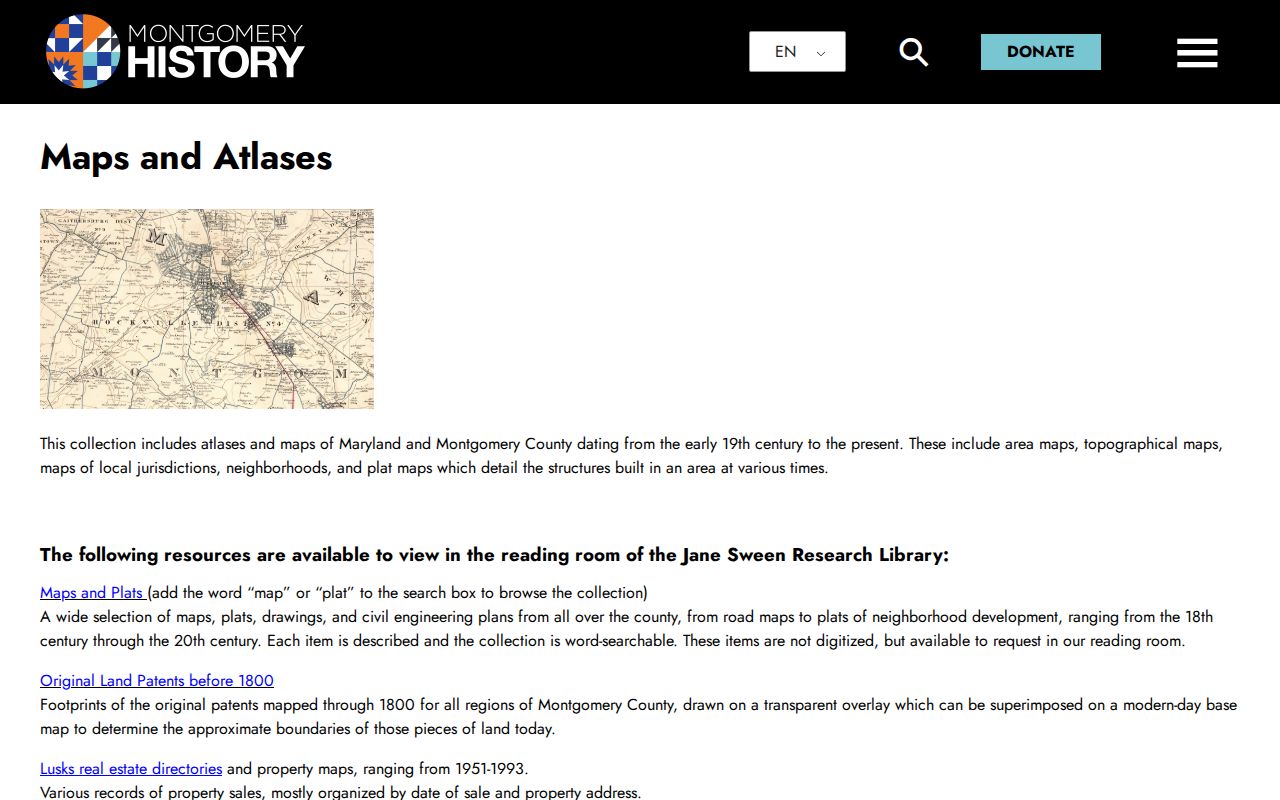
Maps date a place, not its people. The Library of Congress holds Rockville Sanborn maps for 1897 in three sheets and November 1915 in six sheets. Their building footprints, materials, stories, uses, and street geometry can test whether an address or structure existed in the period being researched. Montgomery History broadens the picture. Its map collections add historic atlases, aerial tax maps, and Lusks real-estate directories and property maps from 1951 through 1993. Lusks sale records run mainly by date and address.
The Montgomery History maps and atlases collection is a strong access point for Lusks, Klinge, Sanborn, aerial, and property-sale material. Let a dated map anchor the timeline. Then pair it with deed and directory evidence. A map alone should never carry a person identification.
Rockville's permit record splits at October 25, 2021. The city permit and property-history service sends older applications to Permit Plan and later ones to MGO. A no-result in one system proves nothing about the property.
Rockville Previous Residents for Lawful History
Keep house-history and family-history research tied to a lawful, personal purpose. The good questions are historical ones. Ask when a building changed hands, whether a family appears at a place in a given period, or how a street name connects across time. Some trails simply end. Protected addresses, private household information, sealed records, and records not yet digitized can all stop the search. Follow the custodian's access route or accept the gap.
Lawful use. Use Rockville previous-resident records for personal history, genealogy, estate research, or property curiosity. Do not use information to stalk, harass, or harm anyone; Maryland Criminal Law Article §3-802 addresses stalking.
When a standard title search runs thin, Peerless Rockville and the Jane C. Sween Research Library can help. Their local property files, newspapers, oral histories, maps, and preservation material add real context to a Rockville address. But a missing name proves nothing. Absence never proves absence. People marginalized in property-centered records often never appear in deed evidence at all.